What a great time we had at the Passion Play! Riding the train for six hours, we arrived in Oberamagau in the afternoon. We traveled with two other couples (the Morans and VanDyks.) We all loved the feel of this little town; we got to see most of it as we pulled our luggage down the street to our gasthaus on the opposite end of town from where we exited the train. We had purchased a package deal months earlier for our gasthaus, meals, and Passion Play tickets. Unfortunately, as we arrived at our gasthaus, I discovered that I had forgotten our tickets at home. I had purchased all of the train tickets and was so pre-occupied with those that I didn't even think about the other tickets. We got off easy as it only cost 20 euro to have them re-printed. Thank goodness Barbara had brought the receipt that proved we had bought them.
The Oberammergau Passion Play dates back to a vow made in the year 1633. At that time the plague raged in the entire region, including Oberammergau. Many people died. It was then that the people of this town vowed to portray the "Passion, Death, and Resurrection of Jesus" every ten years. From that moment on not one person succumbed to the Black Death.
Since there are no outsiders permitted to participate in the play, the majority of the residents of Oberammergau were the actors, actresses, and stage-hands. The play runs for six months from April to October and is over six hours long. The open air theater holds 5000 people. It was definitely worth the effort we made to get there.
We had extra time to lazily walk around the town taking in all the sights, sounds, and smells. At one point we came upon a house set back off the road, but there was a showcase on the road of their wood carvings. After sending Bruce in to see if we could look at their carvings (the rest of us were chicken!) we were invited in by a very nice older couple. Their work was outstanding! They did all their own work, assisted by their son. The wooden marionettes had carved faces both front and back. We have one on order and should receive it by Christmas.
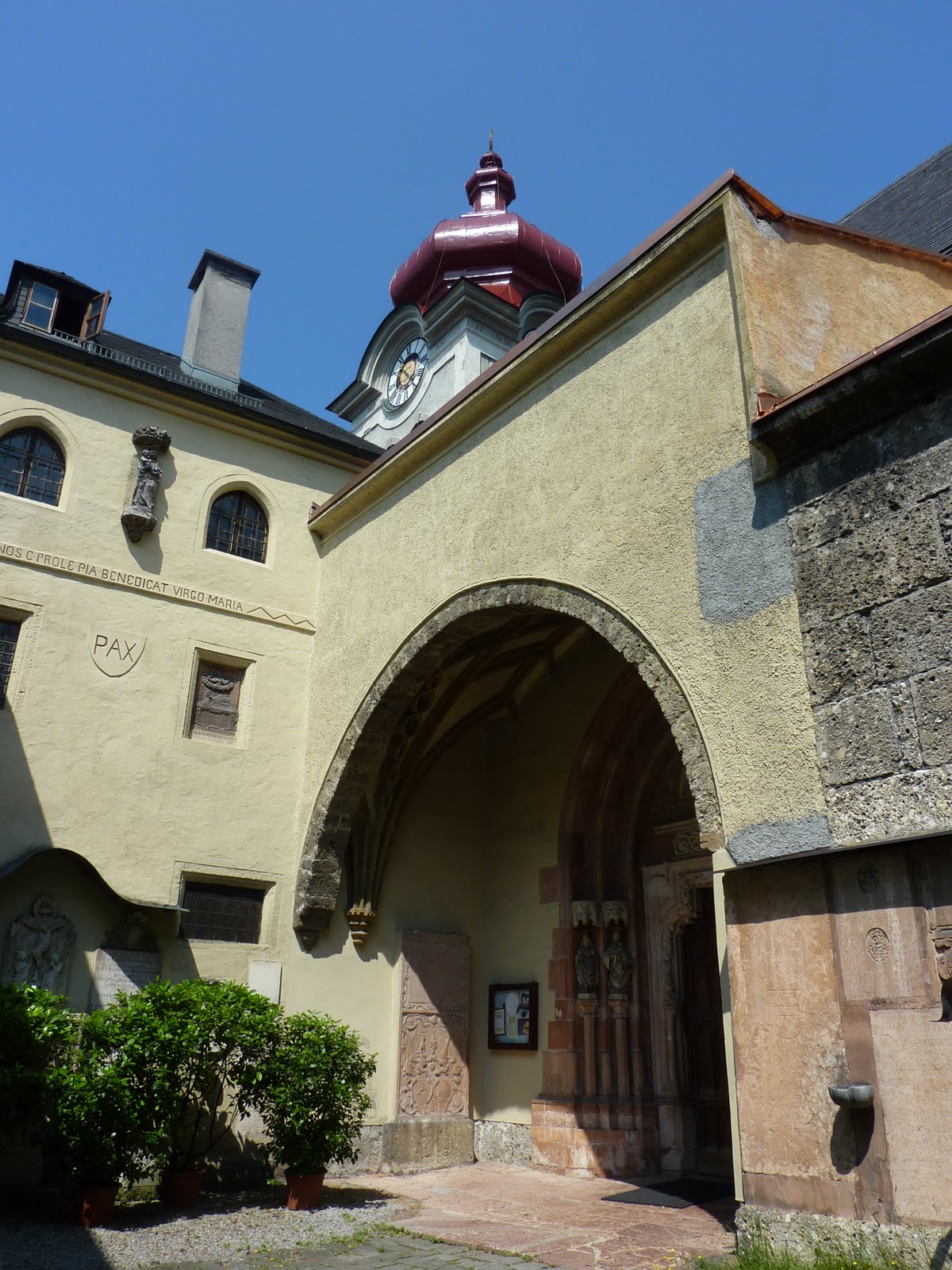
The Gasthaus where we spent two nights
The stage of the open air playhouse
Herr Buehner, his wife, and their son.
When we walked into their yard Herr and Frau Buehner were having breakfast on the porch that overlooked their magnificent yard. They told us the story of how he longed to marry his sweetheart and her parents were not sure he could support her so they insisted that he go to Master woodcarving school. He did and his master carving (a shepherd) holds a place of honor in their home.
Some of the marionettes that were carved by Herr Buehner and his son, then painted by Frau Buehner
The rolling hills of Oberammergau with a castle perched at the top.
Our little group doing one of the things we do best: eating! Oh, and did I mention coffee breaks?
After leaving Oberammergau, we headed to Salzburg. It was a beautiful sunny weekend that proved perfect for our sightseeing. The highlight of the weekend was the Frauline Maria bicycle "Sound of Music" tour. For 3 1/2 hours we rode through the city and all over the countryside. It took a while to get "Do, Re, Mi" out of my head! Salzburg is a city rich in history and culture and we enjoyed our stay there very much.
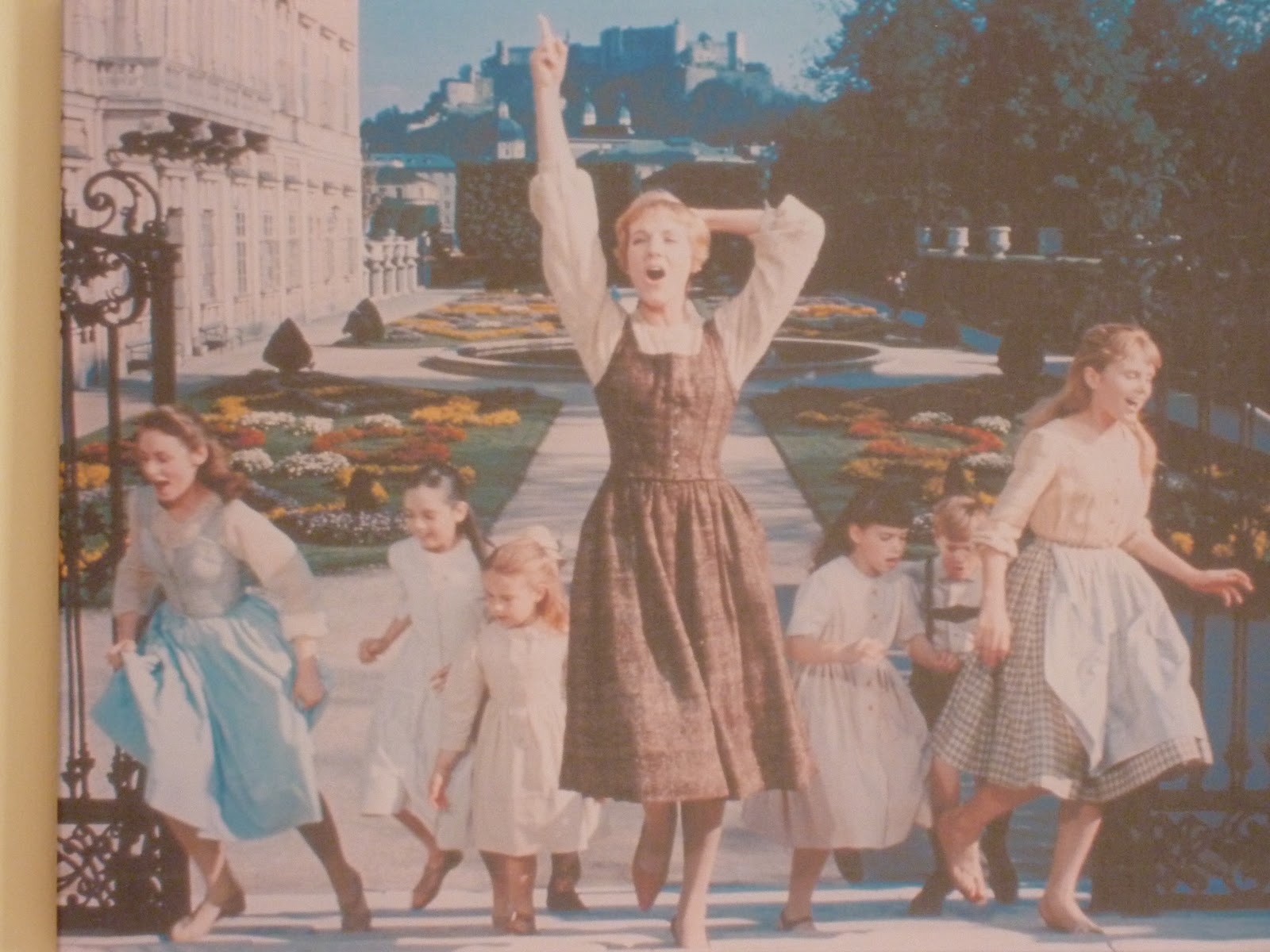
The picture on the wall of the room in our hotel. Would believe we were on the "Sound of Music" floor?!
Greg's lame attempt to copy Maria on the same exact steps.
:)
The gazebo-what a lovely couple!
The scenes in the movie of the front and back of the house are actually two different houses. This is the house where they were attempting to quietly escape (out the front) in the their car when the police discovered them.
The comment was made by two "early twenty" girls that they were surprised we would be doing the bike tour and not the bus tour. Hmm.... Are we getting old or what! I think we kept up with them just fine.
The Baptist church where Euel attended before marrying Mom gave a cross in his honor to hang on their "Memory Wall."
After a long dry spell from posting on my blog I'm going to try to get back on track. I was in the States six weeks visiting family, friends, and helping my Mom with my terminally ill step-dad (Euel.) He passed away on 9/1 and I was able to get back to Vienna a week later.
This is the little country church in Pickton, TX where Euel attended
Two days after I got home Greg left for ten days in Russia. I was thankful for friends from Texas who came to visit us during that time. Now the company is gone, Greg's back, and I've had a few days to rest up some.
My friend, Lucia (friends since 5th gr.) and her husband, Alan, check out the bags at the naschmart.
On Saturday night we attended the Long Night of Museums in Vienna. 105 museums were open from 6 pm-1am. We pooped out at 11:00 and walked in rain (which we were not equipped for) to a bus stop to return to our apartment.
I think one of the most interesting museums we visited was the Vienna Tram Museum. This museum houses 100 original vehicles: tram carriages, city railway carriages, and buses from 1868 to 1978. We actually got to ride on a bus from the year 1936 from the ubahn to the museum. As we squeaked and rattled down the street there were many who stopped in their tracks just to observe this phenomenon.
I've not seen so many smiling faces my entire time in Vienna. The cars were decked with beautiful wood and chrome on the insides. As I climbed the stairs to the top of the double decker bus my head touched the ceiling. Talk about claustrophobic! The Vienna Tram Museum is the world's largest tram museum, which exclusively exhibits the history of public transport within a single city, the city of Vienna.
The following paintings were from the "Young Artist Museum:"
(Feel free to interpret them, if you dare!)
Our next stop was the Belvedere Museum (about a 20 minute walk from our apt.) The Belvedere's palaces are considered to be among Europe's most outstanding Baroque buildings and house the most significant collection of Austrian art dating from the middle ages to the present day. At the heart of the displays of art around 1900 are the world's largest Gustav Klimt collection. We were greeted at the front door by people dressed as vampires who were advertising the upcoming musical, "Tanz der Vampire" (dance of the vampire.) There were photo opts available with two of the vampires in front of a well known painting of Klimt's, "The Kiss." It was quite humorous to watch as one after another teenage girl took their turn between the two vampires to be photographed.
So many of these artists led such depressing lives. Klimt had one affair after another and it is believed that he fathered over 14 children. It is evident that there was little commitment to anything in his life. How sad!
One of Klimt's paintings, "Portrait of Adele Bloch-Bauer I" sold for $135 million to a museum in NY where it has been displayed since 2006.
No photography permitted at the Belvedere.
The line for the "Frida Kahlo" art exhibit at a bank was out the door and down the block. Greg had taken a friend there and concluded I probably wouldn't have enjoyed it too much anyway. She was a very confused and strange woman-I don't think I missed much.
We were privileged to have Kathleen and Brianna visit us for four days. We knew Kathleen and her family when we lived in Fairfax, VA. She and Brianna (from Atlanta) are interning at the US Embassy in Athens, Greece for the summer. They certainly packed in a lot of sightseeing in the short time they were here. I was able to go with them a few days. We visited the Belvedere Palace, the Military Museum, the UN, Hundertwasserhaus, and an Austrian Heuriger. One evening we strolled around Stephansplatz and of course, consumed a little Gelato.
Belvedere Palace
(former residence of the Prince of Savoy)
This is a 15 minute walk from our apartment.
We really enjoyed eating one evening near the Vienna Woods at a Heuriger. These are typically family owned little outdoor cafes, each boasting it's own distinct wines grown in their vineyards. Bruce and Barbara joined us.
The Hundertwasser house, designed by Austrian artist Friedensreich Hundertwasser, was built between 1983 and 1986. It features uneven floors, a roof covered with earth and grass, and large trees growing from inside the rooms, with limbs extending from windows. Hundertwasser took no payment for the design of the house, declaring that it was worth it, to prevent something ugly from going up in its place.
Within the house there are 52 apartments, four offices, 16 private terraces and three communal terraces, and a total of 250 trees and bushes. The Hundertwasser House is one of Vienna's most visited buildings and has become part of Austria's cultural heritage.
Greg was able to give the girls a tour around the United Nations building, showing them his office and describing what he does. It was a very hot day and we welcomed eating lunch in the air conditioned cafeteria.
The Heeresgeschichtlisches Museum (History of Military Museum) was the first Viennese museum. The styles of this town's oldest historic building range from Byzantine, Hispano-Moorish to
Neo-Gothic.
In five major sections the museum shows the history of the Habsburg empire from the end of the 16th century until 1918 and Austria's fate after the dissolution of the monarchy up to the year 1945.
Early Monday morning we traveled to Auschwitz, Poland by train with the Youngs (my cousin, Cindy, her husband, and four children.) We changed trains at Zebrzydowice ( a rather dismal looking train station) where we had our picnic lunch on a dilapidated, rusty old bench.
We went through this to get from one side to the other of the tracks.
It's a good thing we brought our lunch since there was not even a vending machine at any of the stations.
A little reading aloud of "The Mozart Question" purchased at the British Bookstore in Vienna.
Due to a language barrier we had trouble confirming that the Polish trains that we took were the ones called for in our itinerary. I couldn't help but think that the uncertainty and anxiety we experienced was trivial compared to that experienced by those disembarking at Auschwitz 70 years ago. When the rains began it seemed that tears were falling from heaven in grief for the atrocities perpetrated there. Indeed, it might not be inappropriate for Auschwitz to be permanently overcast and rainy. The Austrian train we got off felt luxurious compared to the dingy old train we boarded. Halfway between Zebrzydowice and Oswiecim the skies darkened portending the somber experience to come.
As we entered the grounds at Auschwitz our initial impression was that it appeared to be an innocuous and picturesque little camp. We were about to discover that this was far from the truth.
In the beginning only men were brought to Auschwitz. Those who could play an instrument were enlisted to compose an orchestra, not for entertainment, but to help the officers count the prisoners who were marched from the camp for their daily work detail and returned in the evening.
Members of the Polish resistance were among the first to be interred by the Nazis at Auschwitz. Much later, the Greeks, believing that there were better job prospects further north actually purchased train tickets from the Nazis. Thousands from most European countries (and as far away as 1500 kilometers) were taken to Auchwitz
We visited both the museum area and Berkinau (Auschwitz II-the larger concentration camp built to process and exterminate prisoners more efficiently.) The scale of the atrocities committed at Auschwitz were shocking, but the magnitude of the Berkinau extermination operation was staggering. Toward the end there were as many as 4000 a day who lost their lives. The highest price was paid by Hungary; over 400,000 Hungarian Jews were murdered in the gas chambers.
On their striped uniforms, prisoners wore symbols that indicated the Nazis' reason for singling them out: Jew, homosexual, government official, social deviant, etc. The SS hired photographers to make portraits of each prisoner when he was registered. Many of these portraits hang on the walls of the museum, each showing the prisoner's name, date of registration, and date of death. The average time between the two dates was only about three months. Starvation, torture, forced labor, and disease caused the death toll to rise quickly.
Berkinau
This is what's left of the gas chambers that were built outside of town so as not to be discovered. The SS bombed them to erase the evidence.
It was so difficult to see all the hair (men and women's heads were shaved) piled up in a large glassed in area, as well as hair brushes, eye glasses, and shoes. Especially difficult for me was all of the children's shoes.
We were glad for the comfortable hotel to retreat to at the end of this day. After a nice dinner with the Young family we saw them off to catch their night train to Prague. Greg and I had time the following day to walk around the town before boarding our early afternoon train This area has been so oppressed by war, holocaust, and communism, but there is presently an effort to spruce it up a bit.
We arrived back in Vienna two hours late after train troubles at Zebrzydowice. After 1 1/2 hours a new engine was located and attached to our train. Once again we had rain, cool temperatures, and dreary conditions as we continued on our way.
On Wednesday I boarded a bus at the Vienna International Center to visit the Zentral Friedhof (Central Cemetery.) It wasn't the most pleasant day to tour a cemetery as it was steadily raining, windy, and very cool. Due to the weather we were not able to see as much as was planned. We were able to visit the Ehrengräber (special) section where composers, writers, artists, and politicians are buried. The cemetery opened in 1874 and three million have been buried there in the last 133 years
Here are a few of those buried there:
Johan Straus (1825-1899) was the son of that other Johan Strauss who composed the Radetzky March. He was born and died in Vienna.
Ludwig von Beethoven (1770-1827) was the author of nine symphonies and one opera. He began to change directions from pianist to composer in 1800 when he gradually began losing his hearing. He became totally deaf in 1815.
Johannes Brahms (1833-1897) was famous for his piano concerts and of course, his compostions. Inspite of being in love two times in his life, he died a bachelor. He also hated cats.
Franz Schubert 1791-1828) was composer of "Die Winterreise" and many other works, including twelve operas, nine symphonies, and over 7000 songs. He died at a young age and his death was attributed to syphilis.
Beethoven
Brahms
Straus
The next day found us near the Karlplatz area for the Third Man Tour. We donned helmets with lights and walked down narrow concrete steps through a man hole to tour the same sewer area that is in the movie, The Third Man. The smell was not pleasant, but I was amazed by how long and massive it was. We actually were able to tour three areas. There is a river down there that flows extremely fast.
The movie was set in post WWII Vienna, with emphasis on black market profiteering occurring at that time. The film's villain, Harry Lime played by Orson Welles, was becoming rich from his involvement in racketeering in watered down penicillin. There is a great final chase scene that takes place shot on location in Vienna, mostly at night . Well, actually, there is one little bit of behind the scenes information like the fact that Orson Welles was so put off by working in the actual sewers that he refused to return and the crew had to build a sewer set at Shepperton Studios.
The boots that the sewer workers used to wear, but they were discontinued because of the spikes that damaged the concrete. They weren't too happy since these boots lasted ten years and the ones they have now wear out in a year.
Down the narrow concrete stairs after entering the manhole
I have so much to blog about and can't seem to stay on top of it. I've been so anxious to share with you my pictures from the Italy trip.
I absolutely loved the houses and buildings in Italy.
No cars allowed in Venice as all transportation is by water. The buildings on the waterways are built directly into the water.
Observing the daily living of people of Italy-I love it!
Rosanna is from Italy and is in my UN Women's Guild Yoga class. When she offered to organize a trip and be our tour guide, ten women (representing U.S., Canada, Austria, Lithuania, Indonesia (Bali), Holland, the UK, and Iraq) in our class jumped at it.
Since Rosanna is from Trieste, that is where we spent our nights. Our hostel was right on the Mediterranean Sea. So, for 22 euro each a night we had a very adequate place to rest our weary bodies.
Oh, I forgot to mention we had a sleeper car on the train going and coming. My friend, Barbara, and I bunked with Irina and Danute from Lithuania. We were able to communicate fairly well with only a few hitches. We taught them to say "ya'll", which was hilarious with their Lithuanian accent. The first day we traipsed across Trieste, a city in the upper northwestern part of Italy, along the coast, that once was part of Austria. Warmer than Vienna, we observed that the flowers and gardens were much further along. Their vineyards displayed more leaves and the fields teaming with poppies were a sight not to miss.
Our first stop in Trieste was the Castello and Parco di Miramare (an amazing castle right on the coast), the home of Archduke Maximilian of the Hapsburg family and his wife, Charlotte.
The Castle-
every room looked out over the sea.
Next was a self-guided audio walking tour. Barbara, Irina, and I were a team. We forged up and down cobblestone streets, into ancient churches, and past Roman ruins. The directions were not so clear at times and we missed a few turns. With the help of two locals we got back into town in one piece.
Looking down on the city of Trieste from the
church in Trieste.
Reservations for dinner at Vecchia alla Lira proved to be an excellent choice. The seafood (straight from the sea that day) pasta was the best I've ever had. We even had sardines that were amazing.
Next day found us boarding a train for a day in Venice. After arriving, toilette stop was first on the agenda. We gladly gave up 80 cents in order to use "real" toilets instead of the holes in the floor we had already encountered.
With a day of a lot of walking ahead of us we began our sight-seeing in the Rialto Bridge area where we visited the fish market. Wow! I've never seen so many strange looking fish. The fish that were so scrumptious the previous night just didn't look quite as appealing in the raw.
Pizza in San Marco Square was the choice for lunch. After all, can't go to Italy and not have pizza at least once!
Next stop was the Cathedral. The beauty of these old cathedrals is incredible and unbelievable. We are glad to have these places to be in awe of, but at the same time wondered how they could justify spending so much when many people were in need.
After this we headed for a beautiful park for a much needed "gelato break." I think I actually like the gelato in Vienna a little more. We then boarded the vaparetto (taxi boat) for a 40 minute ride back to the train station to head back to Trieste. After a bit we realized that we had taken the wrong train and we ended up having to fork over 12.75 euro more for going to Trieste the "long" way.
This conductor probably wished he'd called in sick on this day. There was a lot of yammering about having to pay more money for an extra hour by women who he could not even understand.
Our last morning in Trieste found us doing yoga along the sea. It was so relaxing and refreshing and there a few of us who just couldn't resist getting our feet wet. Irina had put her swimsuit on under her exercise clothes so she wins the prize for getting the wettest!
Our last day we rode on a mini bus to Aquileia and Grado, which in my opinion, was the best day. As Rosanna explained it, Aquileia was the grandmother of Venice. When Attila the Hun came through and drove everyone away, they went to Grado. Then when he came through Grado, the people went to Venice.
The mosaic flooring from the 4th century in the Basilica was incredible. It must be extremely resilient to have endured through the centuries.
Roman ruins are the predominant sight in Grado and Aquileia It would not at all surprise me to hear that discovering Roman artifacts in people's personal gardens is not a common occurrence. Meandering through the streets of Grado was lovely. There were older people leisurely riding bikes to do their errands. We had lunch at a nice little outdoor Italian cafe in Grado then headed to the Trieste train station for last minute shopping before boarding the train home.
Hats off to Rosanna for a very well planned trip. She worked hard to ensure that we had a great time.
Amazingly enough, with ten women 49 yrs. and older, there was no illness or mishaps. We all enjoyed each other's company and grew to respect each other even though we were from so many different walks of life.